
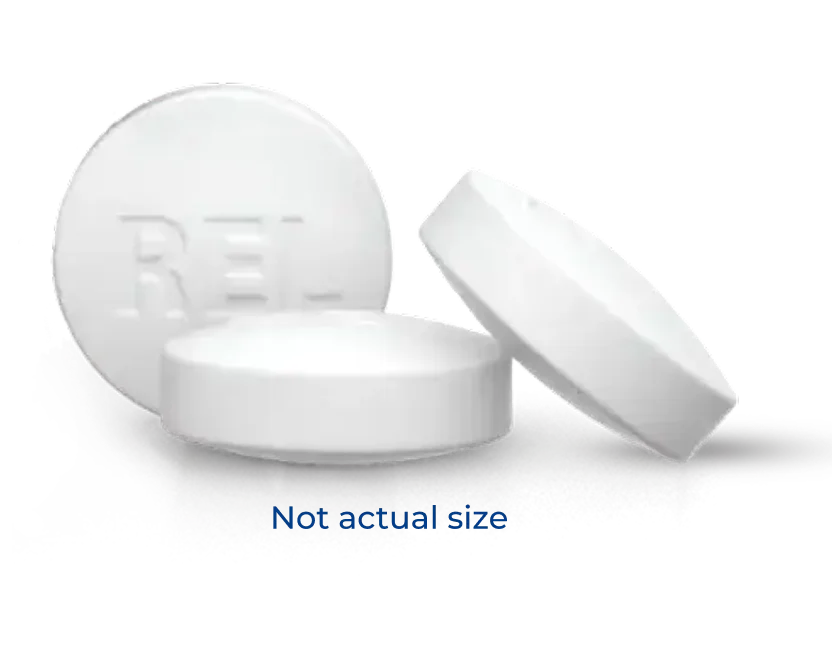
MOST COMMON ADVERSE REACTIONS
In the 4-week, double-blind, placebo-controlled period of the clinical study in patients with opioid-induced constipation (OIC) and chronic non-cancer pain (CNCP) (n=401) (Study 1)1
| ADVERSE REACTIONS* | RELISTOR TABLETS 450mg
(n=200) |
PLACEBO
(n=201) |
|---|---|---|
| ABDOMINAL PAIN† | 14% | 10% |
| DIARRHEA | 5% | 2% |
| HEADACHE | 4% | 3% |
| ABDOMINAL DISTENTION | 4% | 2% |
| VOMITING | 3% | 2% |
| HYPERHIDROSIS | 3% | 1% |
| ANXIETY | 2% | 1% |
| MUSCLE SPASMS | 2% | 1% |
| RHINORRHEA | 2% | 1% |
| CHILLS | 2% | 0% |
*Adverse reactions occurring in at least 2% of patients receiving 3 RELISTOR 150-mg tablets (450 mg total) once daily and at an incidence greater than placebo.1
†Includes abdominal pain, upper abdominal pain, lower abdominal pain, abdominal discomfort, and abdominal tenderness.1
- RELISTOR tablets are contraindicated in patients with known or suspected mechanical gastrointestinal obstruction and patients at increased risk of recurrent obstruction, due to the potential for gastrointestinal perforation
- Adverse reactions of abdominal pain, diarrhea, hyperhidrosis, anxiety, rhinorrhea, and chills may reflect symptoms of opioid withdrawal1
-
Discover RELISTOR tablets
RELISTOR tablets provide patients with CNCP the convenience of once-daily oral therapy1
- Learn more
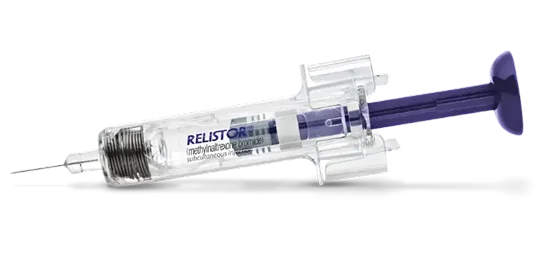
Relistor subcutaneous injection has a well-established safety profile
Most common adverse reactions occurring in ≥1% of patients at an incidence greater than placebo 4-week, double-blind, placebo-controlled clinical study in adults with OIC and CNCP (n=312) (Study 2)1
Patients with OIC and CNCP
| ADVERSE REACTIONS* | RELISTOR INJECTION
(n=150) |
PLACEBO
(n=162) |
|---|---|---|
| ABDOMINAL PAIN† | 21% | 7% |
| NAUSEA | 9% | 6% |
| DIARRHEA | 6% | 4% |
| HYPERHIDROSIS | 6% | 1% |
| HOT FLUSH | 3% | 2% |
| TREMOR | 1% | <1% |
| CHILLS | 1% | 0% |
- RELISTOR injections are contraindicated in patients with known or suspected mechanical gastrointestinal obstruction and patients at increased risk of recurrent obstruction, due to the potential for gastrointestinal perforation1
*Adverse reactions occurring in at least 1% of patients receiving RELISTOR injection 12 mg subcutaneously once daily and at an incidence greater than placebo.1
†Includes abdominal pain, upper abdominal pain, lower abdominal pain, abdominal discomfort, and abdominal tenderness.1
‡Adverse reactions occurring in at least 5% of patients receiving all doses of RELISTOR injection (0.075, 0.15, and 0.3 mg/kg) and at an incidence greater than placebo.1
Adverse reactions from all doses in double-blind, placebo-controlled clinical studies of RELISTOR injection in adult patients with OIC and advanced illness (Studies 4 and 5)1
Patients with OIC and advanced illness
| ADVERSE REACTIONS‡ | RELISTOR INJECTION (n=165) |
PLACEBO (n=123) |
|---|---|---|
| ABDOMINAL PAIN§† | 29% | 10% |
| FLATULENCE | 13% | 6% |
| NAUSEA | 12% | 5% |
| DIZZINESS | 7% | 2% |
| DIARRHEA | 6% | 2% |
STUDY DESIGN: IN ADULT PATIENTS WITH CHRONIC NON-CANCER PAIN
Study 2 included a 4-week, double-blind, placebo-controlled period in which adult patients were randomized to receive RELISTOR injection 12 mg subcutaneously once daily (150 patients) or placebo (162 patients). After 4 weeks of double-blind treatment, patients began an 8-week open-label treatment period during which RELISTOR injection 12 mg subcutaneously was administered less frequently than the recommended dosage regimen of 12 mg once daily.1
STUDY DESIGNS IN ADULT PATIENTS WITH ADVANCED ILLNESS
Study 4 was a Multi-center, double-blind, randomized, placebo-controlled study; 154 patients with advanced illness and OIC received a single subcutaneous dose of RELISTOR injection or placebo followed by an open-label 4-week dosing period, where RELISTOR injection could be used as needed, no more frequently than one dose in a 24-hour period.1,2
Study 5 was a 2-week, Multi-center, double-blind, randomized, placebo-controlled trial comparing RELISTOR injection given every other day vs placebo in 133 patients, followed by a subsequent 3-month open-label extension study.1,3
STUDY DESIGN: IN ADULT PATIENTS WITH CHRONIC NON-CANCER PAIN
Study 2 included a 4-week, double-blind, placebo-controlled period in which adult patients were randomized to receive RELISTOR injection 12 mg subcutaneously once daily (150 patients) or placebo (162 patients). After 4 weeks of double-blind treatment, patients began an 8-week open-label treatment period during which RELISTOR injection 12 mg subcutaneously was administered less frequently than the recommended dosage regimen of 12 mg once daily.1
STUDY DESIGNS IN ADULT PATIENTS WITH ADVANCED ILLNESS
Study 4 was a Multi-center, double-blind, randomized, placebo-controlled study; 154 patients with advanced illness and OIC received a single subcutaneous dose of RELISTOR injection or placebo followed by an open-label 4-week dosing period, where RELISTOR injection could be used as needed, no more frequently than one dose in a 24-hour period.1,2
Study 5 was a 2-week, Multi-center, double-blind, randomized, placebo-controlled trial comparing RELISTOR injection given every other day vs placebo in 133 patients, followed by a subsequent 3-month open-label extension study.1,3
- For additional Important Safety Information, please see below
-
Discover RELISTOR subcutaneous injection
RELISTOR subcutaneous injection offers OIC treatment for patients with advanced illness and active cancer pain1
- Learn more
EXPLORE SAVINGS AND RESOURCES
FROM RELISTOR
Learn moreReferences: 1. RELISTOR [prescribing information]. Bridgewater, NJ: Salix Pharmaceuticals. 2. Slatkin N, Thomas J, Lipman AG, et al. Methylnaltrexone for treatment of opioid-induced constipation in advanced illness patients. J Support Oncol. 2009;7(1):39-46. 3. Thomas J, Karver S, Cooney GA, et al. Methylnaltrexone for opioid-induced constipation in advanced illness. N Engl J Med. 2008;358(22):2332-2343.